

By the third week of July, my sleeper cab turns into a metal box that holds heat the way a thermos holds coffee. I've been driving nineteen years, and the nights that break you aren't the long hauls, they're the ones where you're parked at a truck stop with no shore power, windows barely cracked, and the cab still reading eighty-something degrees at midnight. You can't idle all night at half these lots anymore, and even where you can, running the engine just to move air costs fuel and isn't always safe. A small clip on fan sounds like too little fix for that big a problem, but I've been running one clamped to my bunk rail for two summers now, and it's changed how I sleep more than anything else in this cab. It didn't cost me much and it didn't need a mechanic, just a clamp, a battery bank, and about ten minutes of trial and error the first night.
This isn't a review, I've already written the long version on how the BESKAR clip-on fan held up over a whole season of truck stop nights over at my long-term review. This is the actual walkthrough, step by step, of how I set mine up so it does real work instead of just spinning warm air around a hot box. Where to clip it, which way to point it, how to work the window, and how to run it all night without draining a battery you'll need in the morning to start the truck.
No Shore Power, No Problem
You don't need a whole truck stop cooling system to sleep through a July night. A clip-on fan that clamps to your bunk rail and runs off a battery bank costs less than a truck stop shower and works every single night you're parked.
Amazon Check Today's Price on Amazon →Step 1: Choose Your Clip Point in the Cab
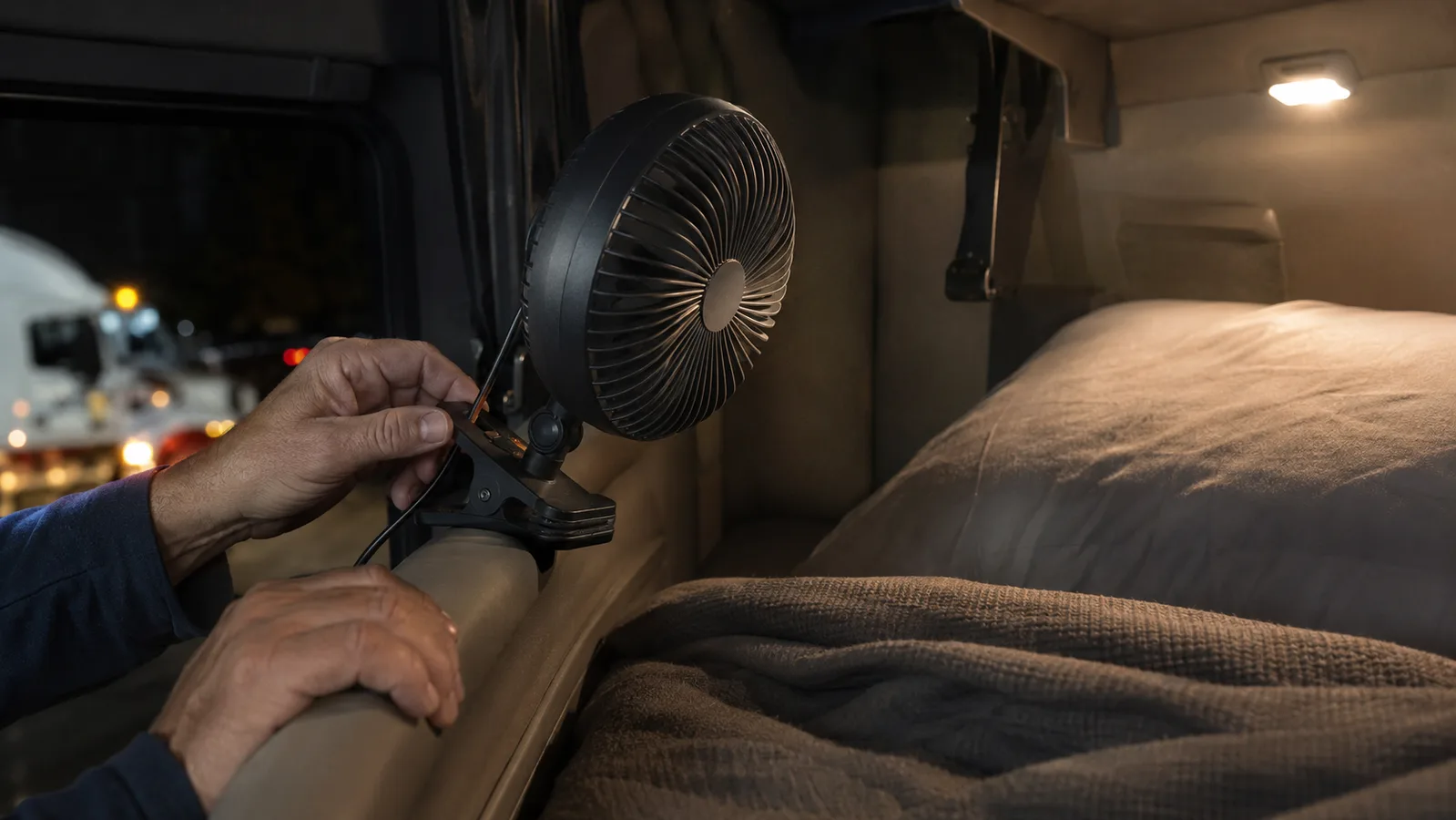
The clamp is the whole game with a clip-on fan. In a sleeper cab you've basically got three places worth trying: the bunk rail right above your head, the shelf lip along the sleeper wall, or the edge of the mattress platform itself if your bunk has one. I run mine clamped to the bunk rail, angled down and across, about eighteen inches above where my chest sits when I'm lying flat. That height keeps it well clear of my face if I sit up fast in the middle of the night, half asleep and not thinking about what's clamped over my head.
Wherever you clip it, the fan has to be somewhere it cannot fall onto the bed if the truck rocks, if you brush it rolling over, or if the clamp works loose over a few hundred miles of vibration. I learned this the hard way on a rig where I'd clipped it to a weaker shelf lip that flexed every time a semi rolled past outside. Test the clamp with a firm tug before you ever plug it in for the night, and check it again every week or two, because plastic clamps do loosen with heat and vibration over the course of a season.
Keep the area around it clear too, curtains, a hanging jacket, loose cords, anything that could drape across the blade guard while you sleep. And this matters more than it sounds like it should: keep fingers and hair away from the guard, especially if you've got kids riding along or you're reaching past it half asleep in the dark reaching for a water bottle. A clip-on fan blade spins fast enough to nick a finger, and the guards on cheaper units have wider gaps between the ribs than you'd expect looking at them in the store.
Before the first real heat wave hits, clamp it up in daylight and check the fit on whatever rail or lip your rig actually has, because bunk rail thickness varies more between trucks than you'd think. A clamp that grips a thin rail with plenty of jaw travel left can sit dangerously loose on a thicker rail in a different cab, so don't assume the fit that worked in your last truck will hold in this one without checking it first.
Step 2: Aim the Airflow Right
Most people clip the fan and just point it wherever the clamp happens to land. That's the difference between a clip on fan that actually helps and one that just makes noise next to your head all night. You want the air moving across your body, not straight down onto your face and not straight into the wall behind the bunk. I aim mine across my chest and shoulders at a slight downward angle, so it's pulling warm air off my skin as it passes rather than just blowing my hair around and doing nothing.
If you sleep on your side most of the night like I do, angle the fan to catch you through a range of positions, not just flat on your back staring at the ceiling. A fan aimed dead center on your pillow works great for the first twenty minutes and then you roll over and lose it completely for the rest of the night. Split the difference and angle it toward the middle of the bunk instead of straight at wherever your head happens to be right now.
Oscillating isn't usually an option on a clamp fan this size, so the angle you set at nine o'clock is the angle you're sleeping with at three in the morning. Take the extra thirty seconds to actually lie down in your normal sleeping position and check the airflow before you settle in for the night, instead of guessing at the angle from a standing position outside the bunk.
Step 3: Crack the Window for Cross-Breeze
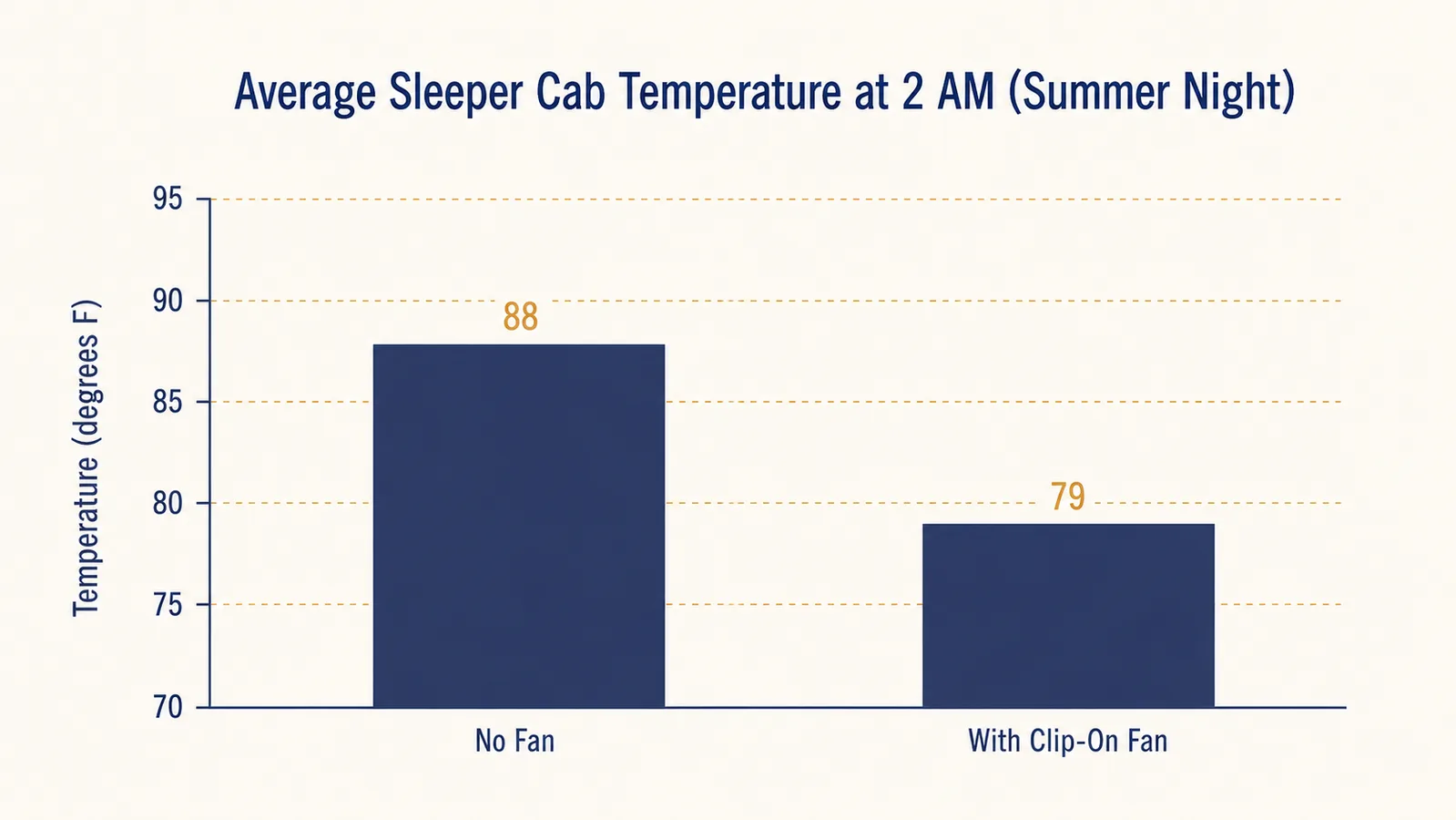
A clip-on fan moving stale air around a sealed cab will cool you a little, but it's fighting a losing battle if there's nowhere for the hot air to actually go. Crack a window an inch or two, on the side the fan is pulling from if you can tell which way the wind's running that night, and you get real cross-breeze instead of just recirculating the same hot air past your face over and over.
I run mine cracked on the passenger side most nights, since my bunk sits driver's side and that gives the fan a clean pull path across the whole cab. Two fingers of gap is usually plenty, more than that and you're inviting bugs and losing your privacy at truck stops where you'd rather not have a window wide open next to strangers walking by.
If you're parked somewhere loud, or you don't feel comfortable cracking a window that much overnight, a bug screen or a slim window vent visor lets you leave a bigger gap without opening yourself up. Either way, the fan needs somewhere for that hot air to actually escape to, or you're just stirring a hot pot all night long instead of cooling it down.

Step 4: Power It Without Idling
This is the part that actually saves you money and keeps you legal in idle-restricted lots. A USB clip-on fan draws so little power that a basic USB battery bank, the kind you'd charge a phone off twice, will run it most of the night on the lowest of its three speeds. I keep a 20,000 mAh bank clipped near the fan itself and it gets me through till morning without touching the truck's electrical system at all, and without me worrying about a dead battery at start-up.
Never idle the engine overnight just to run a fan or keep the cab cool, especially with the windows barely cracked. Idling in an enclosed sleeping space risks carbon monoxide building up inside the cab, and that risk is real even with a window cracked, exhaust can drift back toward the cab depending on the wind and how you're parked relative to other rigs. Plenty of states and plenty of truck stops restrict overnight idling anyway, and a fan pulling a few watts off a battery bank does the job without any of that risk or the fuel cost of running the engine all night.
If you'd rather not manage a separate battery bank, some drivers wire a small inverter off the truck's house battery, but that only makes sense if your rig actually has a separate house battery setup that won't leave you stranded at start-up in the morning. For most of us running a basic setup, a battery bank is simpler, cheaper, and one less thing that can go wrong at five in the morning when you actually need the truck to start and get moving.
Top the battery bank off during the day whenever you're plugged into shore power or running the truck anyway, so it's never a surprise at bedtime. I keep mine on a habit of charging it while I'm doing my pre-trip inspection in the morning, so by the time I'm parked for the night it's sitting at a full charge and I'm not guessing whether it'll last until sunrise on the lowest fan speed.
Step 5: Keep It Safe Through the Night
A few habits that don't cost you anything but matter every single night. Don't drape a blanket or a shirt over the fan to muffle the hum, it can block the intake and it's one more thing near a spinning blade in a dark, cramped space. Don't run it with the guard removed even if you think it'll move more air, the gap in a stock guard is already tight enough to catch a finger if you're groggy and reaching around it half asleep.
Check the cord routing before you settle in too. A cord running across where your feet land when you climb down for a bathroom break at two in the morning is a real trip risk in a dark, cramped cab. I route mine up and along the bunk rail, well out of the way of anywhere I'd actually put my feet climbing down.
Wipe the blades and guard down every couple weeks too. Road dust builds up in a cab faster than you'd think, and a dusty fan just blows that dust straight at your face all night instead of clean air. It's a thirty-second job with a damp rag, and it's the kind of small maintenance that keeps a clip-on fan running quiet and clean for years instead of turning into something you stop using because it's gotten grimy and annoying.
None of this takes more than a minute or two once it's a habit, and it's the difference between a clip on fan that quietly does its job for years and one that ends up as a story you tell at the next truck stop about the night it fell on you or got tangled around your feet in the dark.
What Else Helps
A clip-on fan handles the air movement, but it isn't doing this job alone in a cab that's already baked from the sun all day. A reflective windshield sunshade cuts down how hot the cab gets before you even park for the night, and a set of insulated cab curtains keeps the sun off the bunk itself during afternoon stops when you're trying to catch a nap. I run both alongside the BESKAR clip-on fan I've had clamped to my bunk rail for two summers now, and the combination gets me from an oven at 6 PM to something I can actually sleep in by 10.
If you're still deciding whether a fan this small is worth the cab space, I broke down the specific reasons it's earned a permanent spot on my bunk rail in 10 reasons a clip-on fan helps you sleep cool. Between the sunshade, the curtains, and the fan running off a battery bank instead of the truck's electrical system, I've cut the number of nights I wake up sweating through a shirt by more than half. A pair of foam earplugs helps too, since the fan hum is a lot easier to sleep through than the diesel idling two spots over.
The fan doesn't have to fight the whole cab, it just has to move the two feet of air between the vent and your face. Get that part right and everything else is a bonus.
Clip It Once, Sleep Cool All Summer
A clamp, a battery bank, and a couple minutes to aim it right, that's the whole system. It's held up on my bunk rail for two summers of truck stops, and it's the smallest thing in this cab that's made the biggest difference.
Amazon Check Today's Price on Amazon →