
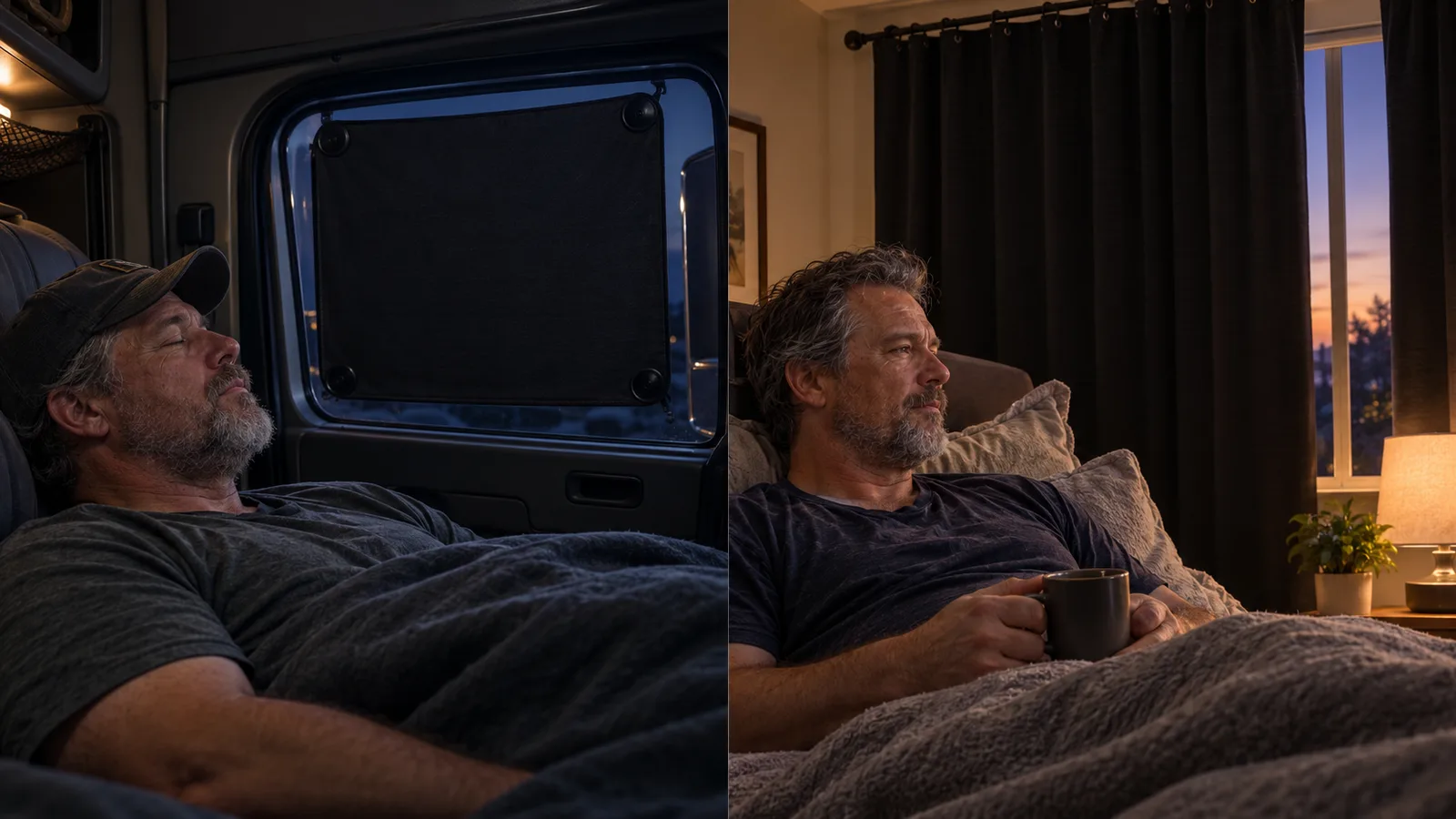
My sleeper cab window is 24 inches wide and about 14 inches tall, cut into the door with a curtain track that has never once closed flush no matter how many times I've fiddled with the slider. My bedroom window back home in Knoxville is a completely different animal, almost six feet across, with a rod mounted eight inches above the frame and room for two full panels of fabric. Over the last year I've used both a DREAM ART Anywhere Portable Blackout Curtain, the suction-cup kind that presses straight onto glass, and a regular pair of rod-hung blackout curtains in that home bedroom. They solve the same basic problem, keeping light out of a room, but they are not interchangeable, and picking the wrong one for your situation wastes money and still leaves you squinting at 5 a.m. Nineteen years of parking in different lots every night will teach you that fast, and it's the reason I finally sat down and compared these two side by side instead of just guessing.
Short answer if you're in a hurry: if you're dealing with an odd-shaped window, a rental you can't drill into, a nursery, a dorm room, or a sleeper cab like mine, the portable suction-cup shade wins, no contest. If you've got a normal-sized bedroom window in a house you own or plan to stay in for a while, regular blackout curtains still cover more ground, look more like a finished room, and hold up longer with basically zero maintenance. Below is exactly where each one pulls ahead, row by row, no hand-waving.
How I Tested Both
I didn't run this as some kind of lab test. I ran the DREAM ART shade on my actual cab door window for six months of real routes, mostly Southeast and Midwest runs out of Knoxville, sleeping in truck stop lots, rest areas, and the occasional cheap motel. Then I put the same kind of attention on the blackout curtains hanging in my own bedroom at home, where Donna and I have lived for going on five years. Two completely different rooms, two completely different jobs, and I tracked the same three things on both: how long setup actually took, how much light still snuck through on a bright night, and how each one held up week after week.
That's the fairest way I know to compare them, because the honest answer to "which one is better" depends entirely on which window you're talking about. A portable shade judged against a bedroom window it was never built for will lose every time, and a curtain rod judged against a sleeper cab door will lose just as badly. So instead of picking a winner, I tracked both against the job each one is actually built to do, then laid the results out side by side below.
| DREAM ART Portable Shade | Rod-Hung Blackout Curtains | |
|---|---|---|
| Price for one window | Around $25 for a single 51 by 71 inch panel, suction cups included | $30 to $100 or more once you add a rod, brackets, and two panels |
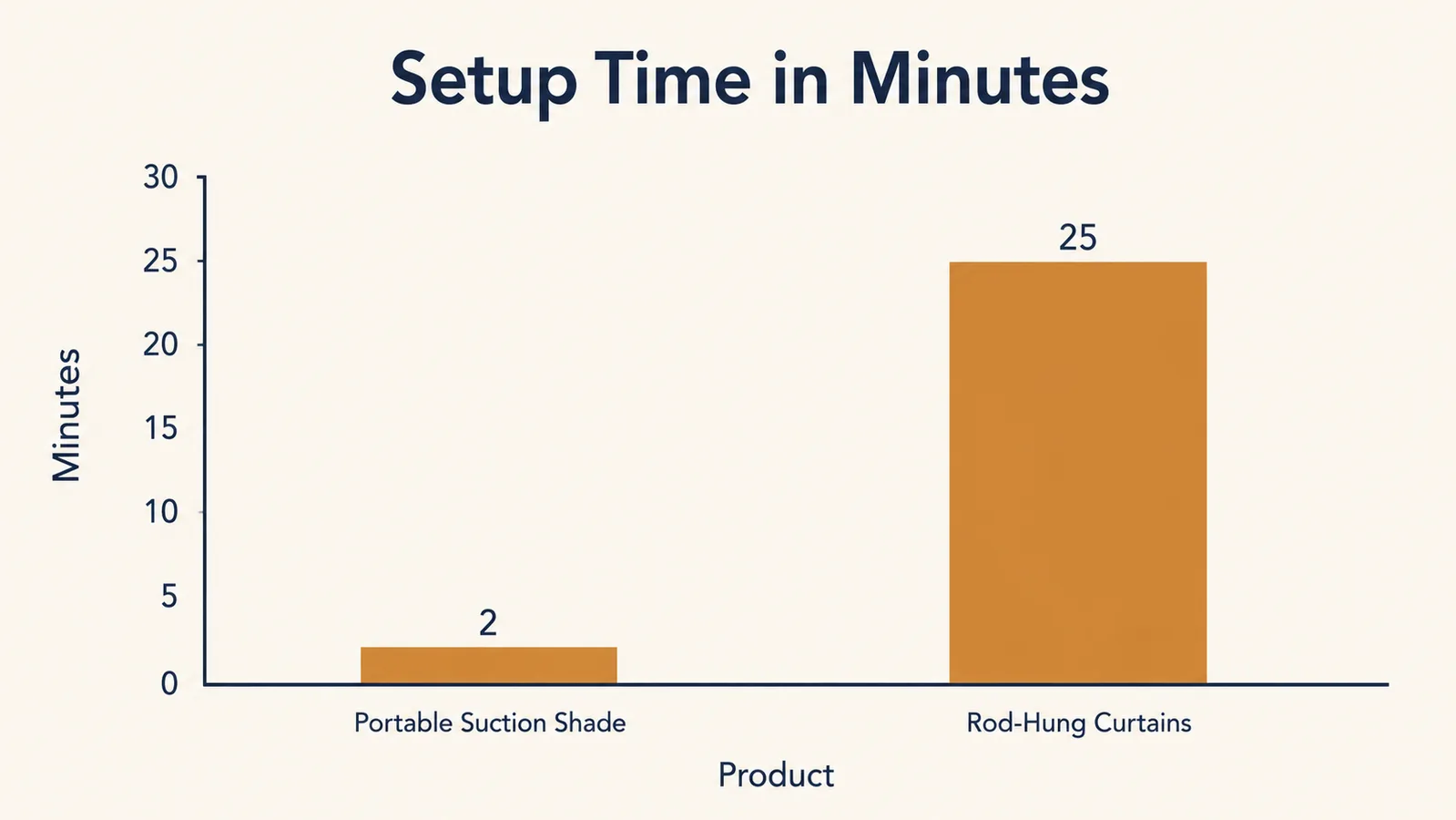
| Setup time | Presses onto glass or a smooth frame in under 2 minutes, no tools | Usually 20 to 30 minutes to mount a rod and hang panels, longer if you're drilling into drywall |
| Portability | Peels off, rolls up, moves from truck to motel to nursery in one bag | Fixed to one rod in one room, not something you pack and move |
| Window size range it covers well | Best up to about 51 by 71 inches, one fixed size for a single pane or cab window | Scales to any window with the right rod length and enough panels |
| Look in a finished bedroom | Functional and a little utilitarian, reads as a temporary fix, not decor | Matches curtains hung as an intentional part of the room's design |
| Sealing light on a hard flat surface like glass or a cab door | Suction cups grip flush glass and metal directly, closing gaps curtains always leave | Panels hang loose at the sides and bottom unless you add a separate blackout liner or side clips |
| Long-term durability | Suction cups can lose grip and need occasional repositioning after months of daily use | Rod-hung fabric panels hold up for years with basically no maintenance |
Where the Portable Suction Shade Wins
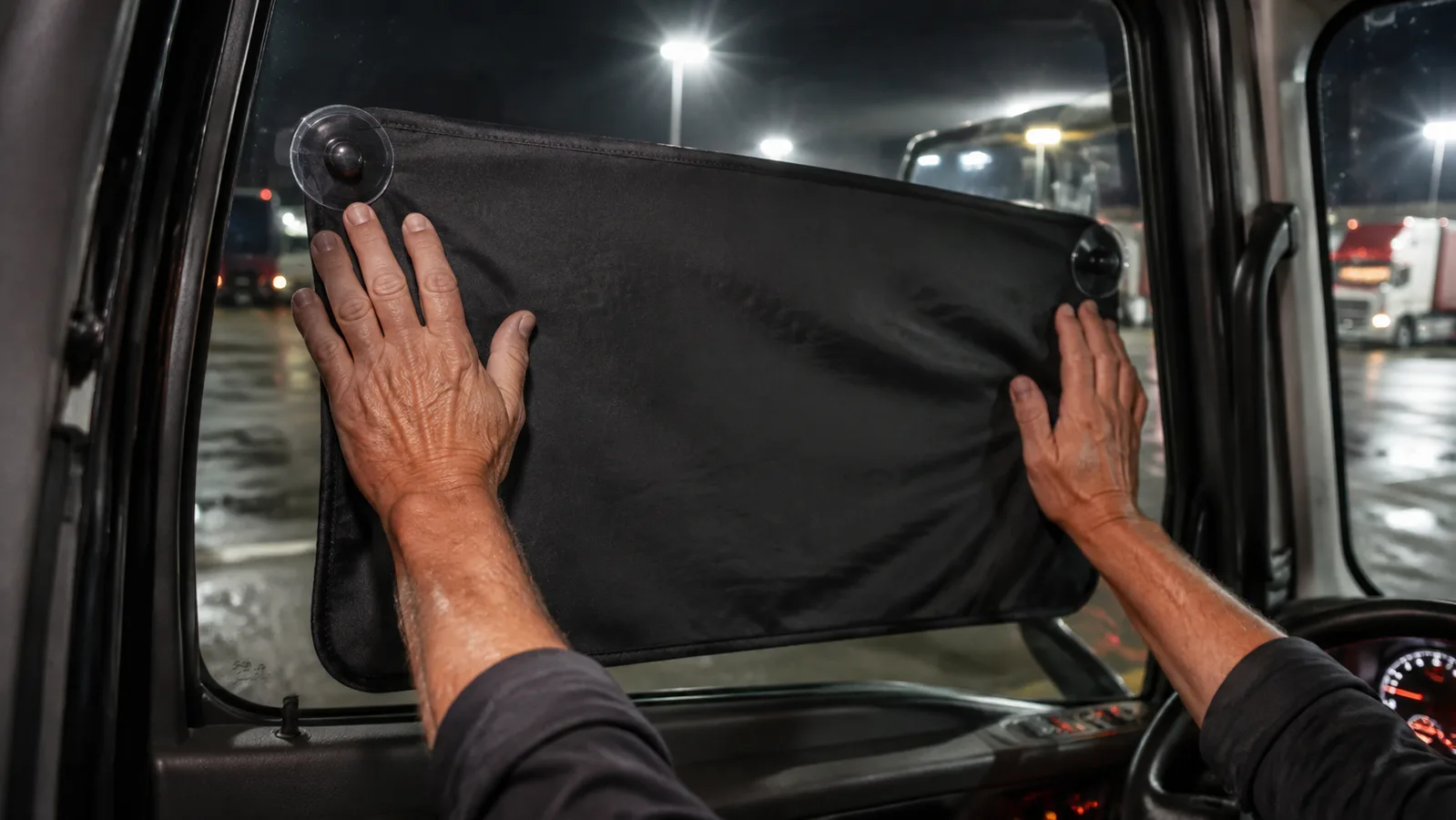
In a sleeper cab, there is no rod to hang anything from, and there's certainly no wall you're allowed to drill into. The DREAM ART shade solves that by skipping hardware entirely. The suction cups press onto the glass or the metal trim around a cab door window, and the whole thing is up in about two minutes flat, even in the dark with a flashlight in your teeth. I've set mine up leaning against the console at a rest area at 1 a.m. more times than I can count, and it has never once needed a screwdriver or a single extra part.
The other thing that surprised me is how well it seals against a completely flat, hard surface. A cab door window is glass, sometimes with a thin metal frame around the edge, and that's exactly the kind of surface suction cups are built for. Regular curtains, by contrast, are designed to hang from a rod with a foot or two of slack fabric on either side, which is great in a bedroom but leaves gaps at the edges that let a truck stop lot light sneak right through. On my own window, the portable shade blocks that stray light better than any curtain gap ever has.
Portability is the other real win. I keep mine rolled up in the door pocket of my cab, and I've used the same panel in a cheap motel room with a window that didn't line up right with the provided curtains, and once at my sister's place when I crashed in a spare room with nothing but a bare window and a baby monitor on the nightstand. A rod-hung curtain lives in exactly one spot. This one goes wherever the next bad window is, which is exactly why I gave it a full write-up in my long-term review after using it for six months on the road.
Cost adds up in the shade's favor too, once you're talking about more than one window. I bought a second panel for my truck buddy Curtis after he rode along one weekend and saw how dark my bunk got compared to his, and between the two of us we're still under what a single set of curtains with a rod would run at home. If you're outfitting a cab, a camper, a dorm room, and a nursery, four portable shades still cost less than decent curtains for one of those rooms alone, and every one of them packs down small enough to toss in a duffel bag when the job's done.
Where Regular Blackout Curtains Win
My home bedroom window is nearly six feet wide, and there's no version of a single 51 by 71 inch suction-cup panel that covers that kind of span without looking like a patch job. Regular curtains, hung on a rod sized to the actual window, scale to whatever you're working with. Wide windows, bay windows, sliding glass doors, curtains handle all of it with the right hardware, where a portable shade is built around one fixed size.
Then there's the look. Donna picked out our bedroom curtains to match the rest of the room, a deep navy that pairs with the bedspread, and they read as furniture, not as a fix. The portable shade does its job well, but it looks exactly like what it is, a temporary panel stuck to a window with suction cups. If you own your home and you're decorating a room you plan to sleep in for years, that difference matters more than it sounds like it should.
Durability is the last piece. My bedroom curtains have hung on the same rod for going on four years now with zero maintenance, just an occasional wash. The suction cups on the portable shade, by comparison, do lose a little grip over months of daily use in a cab that heats up and cools down constantly, and I've had to reposition mine a handful of times. Neither is a dealbreaker, but if you're setting up a permanent room and never plan to move the window covering again, a curtain rod is simply built for that job in a way suction cups aren't.
Heavier curtain fabric also does something a thin suction-cup panel can't, it dampens sound and holds a room's temperature a little steadier. Our bedroom stays noticeably warmer in the winter with those curtains drawn, and quieter too when a storm rolls through. The portable shade is thinner material by design, since it has to be light enough to pack and flexible enough to seal against glass, so it doesn't do much for temperature or noise. In a room you're heating and cooling every day for years, that difference in the utility bill and the quiet actually matters.
Where the Answer Flips
There's a version of this comparison that flips the usual answer, and it's worth naming. My buddy Curtis leases his truck instead of owning it, and his company bans drilling into the cab, period, even into interior trim most drivers wouldn't think twice about. His sleeper actually came with a factory curtain track already installed, the same kind mine has that never closes flush, but the handbook treats that track as decoration, not a mounting point. For him the portable shade isn't just the better option, it's the only one that doesn't risk a write-up. Check that rule before assuming a curtain solution is even on the table.
The flip runs the other way too, right at my own house near Knoxville. Donna's folks drive up from Chattanooga three or four times a year and stay in the guest room, which sits empty the other fifty weeks. I bought real curtains for our bedroom because we sleep there every night, but never for that guest room. A portable shade does the job fine for a room that only earns its keep a handful of nights a year, and it cost a fraction of a second rod and pair of panels. If a room isn't slept in nightly, don't buy it a permanent fix.

A Full Year With Both
Twelve months in, the two products have aged in completely different ways. My cab swings from a Georgia summer that turns the glass hot enough to sting your palm, to a January run through Ohio and Pennsylvania where that same window sweats condensation by morning. That swing is hard on suction cups. The rubber softens in the heat and stiffens in the cold, and I've had to reseat mine more in the dead of summer and the dead of winter than in the mild months between. A five-second fix each time, but the sort of thing you only notice after a full year of every season a route can throw at you.
Back home, the curtains haven't needed a single adjustment in that same year. They've sat through a sticky Tennessee summer with the AC running and a couple of real January cold snaps, and the only maintenance was washing them twice. Heavy fabric doesn't care about temperature swings the way a suction cup does, because it isn't gripping anything, it's just hanging there. Add up a full year and neither product lost the argument. I haven't replaced a single suction cup, just repositioned them now and then, so the real cost past that first purchase has been my own time. The curtains cost more up front and stayed put, which is what you want in a room you're not leaving.
Got an odd window, a rental, or a sleeper cab you can't drill into?
The DREAM ART portable shade handles exactly that problem, no rod, no tools, no landlord to ask permission from. Check today's price and current reviews on Amazon.
Amazon Check Today's Price on Amazon →Who Should Buy Which
If you're a driver like me, a renter, a parent setting up a nursery you don't want to permanently modify, or anyone who needs blackout coverage on a window that doesn't have a rod and never will, get the portable suction-cup shade. It's cheap enough to keep a spare in the glovebox, it goes up in minutes, and it seals better against a hard flat surface than any curtain gap I've ever dealt with. I laid out ten reasons a portable blackout shade is worth carrying, most of which come straight from nights on the road. I'd rather tell you that plainly than pretend one product fits every window in a house, because it doesn't.
If you own your home, or you're settled somewhere long-term with a normal-sized bedroom window, regular blackout curtains are still the better long-term buy. They cover more window, they look like part of the room instead of a patch on top of it, and a good rod-hung panel will outlast a suction-cup shade by years. The honest move is to use both where they each make sense, curtains for the bedroom you're not leaving, and a portable shade for every window that doesn't have a permanent answer yet.
There's also a middle case worth naming, because it's my own situation. I'm on the road five or six nights a week and home the rest, so I own both. The portable shade lives in my truck full time, and the curtains stay put at home. Neither one had to compromise to cover the other's job, and I spent less total money doing it that way than I would have trying to force one product to handle both rooms. If you're weighing this decision for a single window, buy the one built for that window. If you split your time the way I do, there's a good case for owning both.
If my own kids ever asked which one to buy for their first apartment, I'd tell them what I'd tell a driver at a truck stop counter over coffee. Buy the portable shade first, since getting it wrong only costs twenty five dollars, not a wasted afternoon and a rod to return. Live with the window a while, decide if you're staying long enough to justify a real curtain setup, then spend the extra money on something fixed to a wall. That's the order Curtis and my nephew both landed on without planning it, and it's cheaper than guessing wrong the other way.
For the windows curtains can't cover, this is the fix I actually pack.
One panel, no rod, no drilling, ready in under two minutes at any truck stop, motel, or spare room. See current price and buyer reviews on Amazon.
Amazon Check Today's Price on Amazon →