

The first time the DREAM ART Anywhere blackout shade let me down, it was 4:12 in the morning at a truck stop outside Rock Springs, Wyoming, in February, eleven degrees outside and colder than that against the glass. I'd pressed all six suction cups into the driver's side window myself the night before, same as always, and I woke up to a slab of white light lying across my sleeping bag like someone had opened a curtain in a hospital room. One cup had let go sometime around three, the corner had folded down onto the dash, and the security light in that lot did the rest.
That's the review nobody selling this shade wants you reading first, so here it is up front. I already told the long version of my year with this thing in my long-term review, where I walk through what worked across twelve months on the road. This one is different. This is everything that only shows up after you've stuck this same black panel to a dozen different windows in a dozen different conditions, the failures, the size limits, and the light that finds its way in anyway. If you're still deciding whether to buy one, read this one first.
The Quick Verdict
Genuinely blocks light on a clean, room temperature window. Ask it to do that job in a cold truck stop parking lot on dirty glass, and it starts letting you down right when you need it most.
Amazon Check Today's Price →See Today's Price and Real Buyer Photos on Amazon
Check current availability and see what other buyers are saying before you decide.
Amazon Check Today's Price on Amazon →How I've Used It
I bought the DREAM ART Anywhere blackout shade in April, the black one, the 51 by 71 inch panel, after getting tired of taping a moving blanket over my cab window with painter's tape that kept pulling paint off the trim. I ran it in my sleeper cab through spring, summer, and into a rough stretch of winter running lanes through Wyoming and Montana. Somewhere around July, my wife Donna asked to borrow it for our daughter's nursery window at home, so it's also spent four straight months doing exactly the job it's marketed for, a kid's room, on a normal double hung window that never sees a swing worse than a mild Ohio winter.
Two very different jobs, two very different report cards. On Donna's window at home, clean glass, steady indoor temperature, no vibration from a running engine, it did exactly what the package promises. In my cab, moving between a 95 degree afternoon in Texas and a 19 degree overnight in Montana, pressed against glass that's picked up diesel film and road salt more nights than not, it's a different story, and that's the story most reviews skip past.
I kept a rough count starting in October, once the weather turned. Out of roughly forty overnight stays in the cab between October and January, I woke up to at least one suction cup off the glass on eleven of them. That's better than one bad night a week, worse than one bad night a month, and it's the number that made me start writing this instead of just the long term piece.
Installation itself takes about ninety seconds when the window's clean and the cups are fresh, press each corner, then work along the top and sides. That part never got old or slow. What changed over four months was how often I had to redo it mid-night, which is really a comment on the cups, not on how the shade goes up in the first place.
The Suction Cups Are the Weak Link
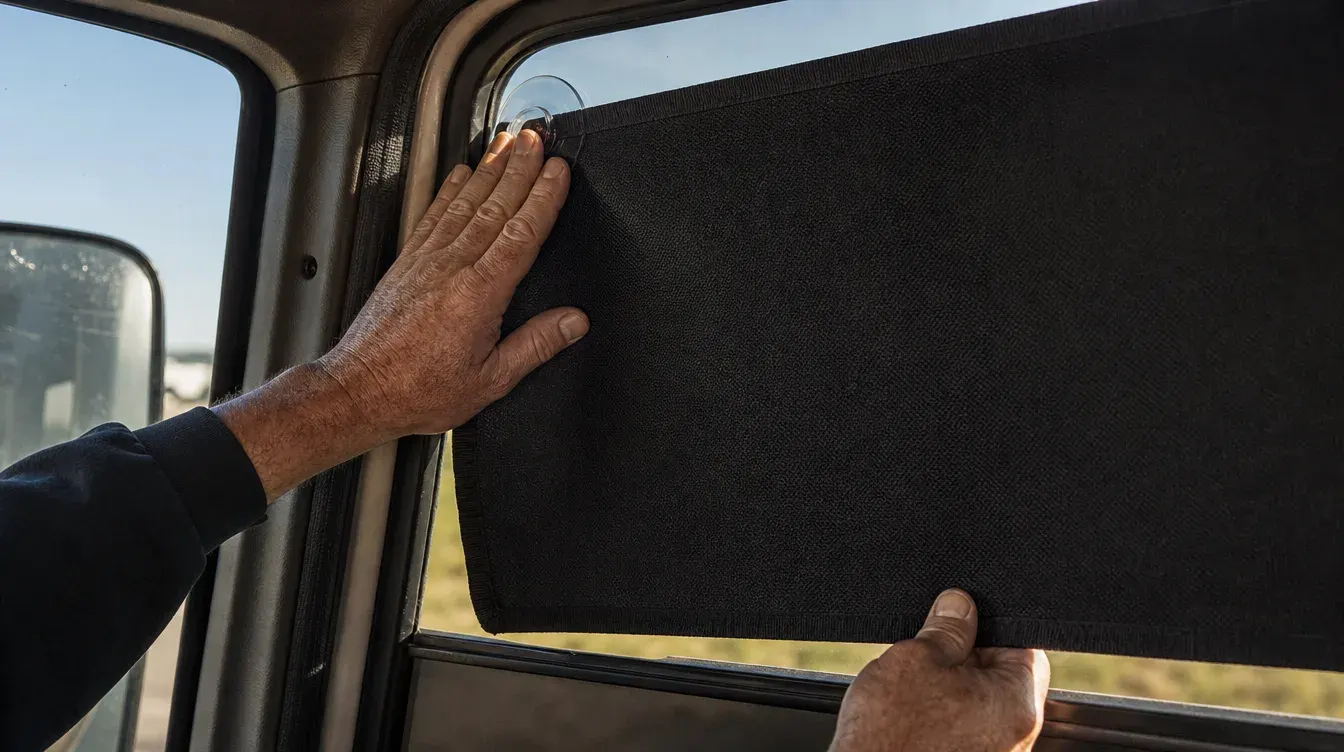
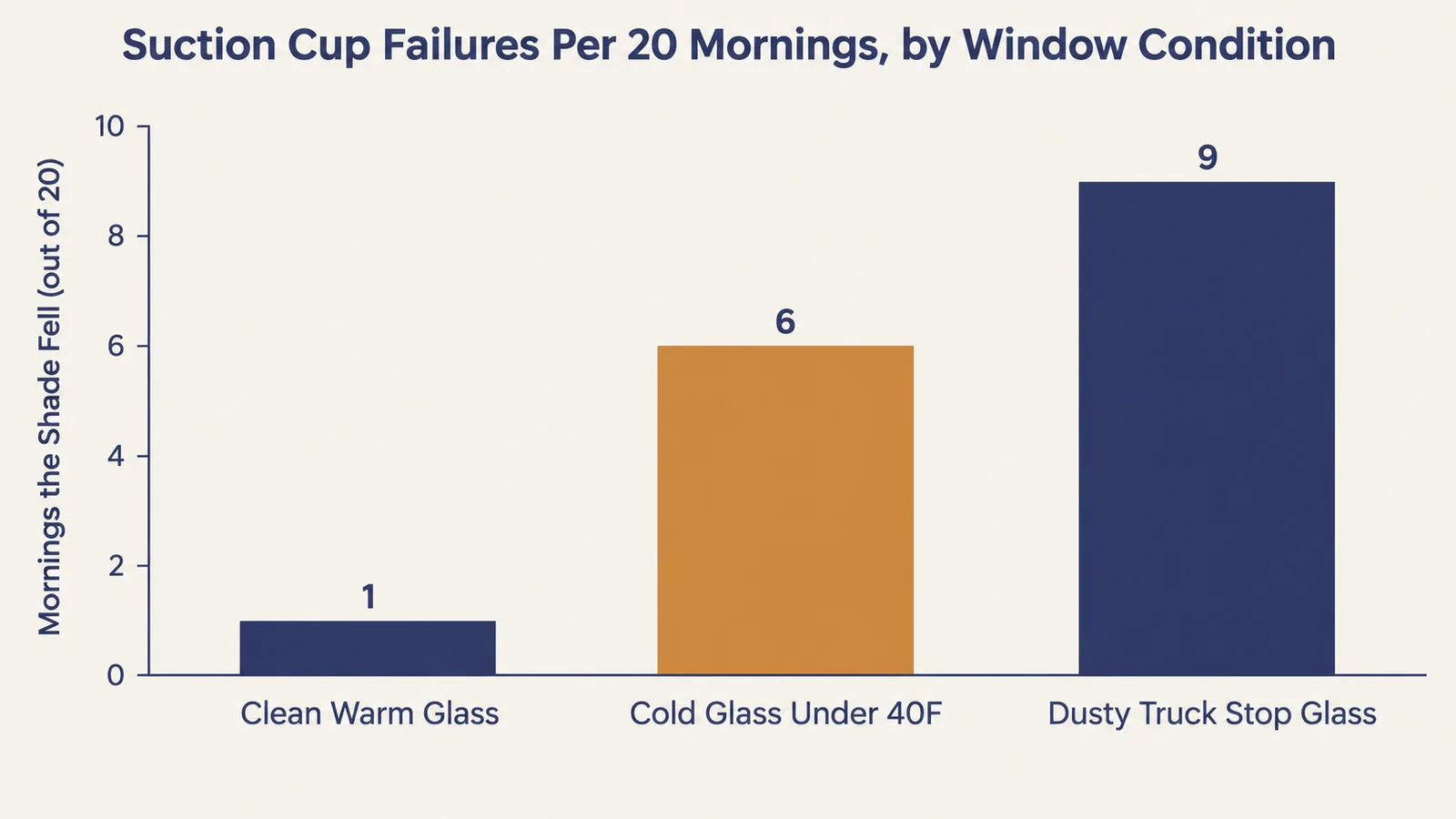
Six suction cups hold this panel to the glass, and six suction cups are also the entire structural plan. There's no frame, no magnetic strip, no adhesive backup, just rubber cups pressing against whatever the window happens to be that night. On clean, room temperature glass, like Donna's nursery window, they hold for weeks without a re-press. On a cold truck cab window in January, I lost a corner or a full side more nights than I want to admit, usually the passenger side, where the glass runs coldest against the outside air.
Suction cups grip through a thin layer of trapped air pressure, and that grip weakens as the rubber stiffens in the cold and as the glass surface picks up grime. Dusty truck stop windows, the kind that never get a real cleaning between oil changes, cut the hold time down to a few hours instead of all night. I started keeping a rag in the door pocket just to wipe the window before pressing the cups on, and that helped, but it's an extra step nobody mentions in the product photos.
I also noticed the cups holding worse in my second and third months of use than they did brand new out of the package. That's not unusual for suction cup rubber generally, it's just something DREAM ART doesn't put on the label, and it's worth knowing before you count on this to seal a window unattended for eight or ten hours straight in real winter conditions.
Wiping the cups themselves with a damp cloth every couple of weeks bought back some grip, roughly like new for a night or two before the cold started working on them again. It's a five minute fix, but it's maintenance, not something you do once and forget, and that's worth knowing if you're the type who wants to set gear up once and never think about it again.
Light Still Gets In at the Edges
Even on a night when every cup holds, this shade doesn't seal a window the way a real blackout curtain seals a room. The panel is cut to cover the glass, not to wrap around the frame, so there's a thin gap running down both sides and along the bottom where daylight finds its way in as a bright pencil line instead of a solid glow. On my cab window, that gap lines up almost exactly with the dash, so a truck stop light hits it at an angle and throws a strip of light straight across the bunk.
A half inch gap doesn't sound like much until you've slept behind it at 5 in the morning in July with the sun already up over a Georgia truck stop. I ended up rolling a bath towel and wedging it along the bottom edge, which fixes most of it, but that's a workaround I had to invent myself, not something the shade does on its own straight out of the box.
At home, this matters less. Donna's nursery window sits inside a deep frame with blinds behind it, so the shade's edge gap gets caught by the blind slats before it ever reaches the room. In a truck cab, where the shade is the only thing between you and a parking lot light, that gap is the difference between total dark and a stripe of light landing right across your face.
Size Limits Nobody Tells You About
This shade comes in one size, 51 inches by 71 inches, and that's the entire catalog. It's plenty for a standard bedroom window, which is exactly who DREAM ART built it for, nursery windows, kids' bedrooms, and hotel windows on a trip. It is not built for a sleeper cab windshield or the big curved side glass some trucks run, and if your window is wider or a different shape than that rectangle, you're either overlapping two panels or leaving a strip uncovered.
In my truck, the driver and passenger side windows fit it close enough with a little slack folded under and tucked behind the sun visor. My windshield doesn't come close, so if total blackout including the front glass is the goal, this one panel by itself isn't a complete fix. That's not really a knock on DREAM ART, a semi windshield was never the target market, but it's exactly the kind of thing you want to measure your own window against before you order, not after it shows up too small.
I also tried it on a motel window outside Amarillo and on my brother-in-law's travel trailer window, both closer to the 51 by 71 inch sweet spot than my cab glass. Both installs went faster and held longer, more evidence that this shade is really built around a standard home-sized window, with a truck cab as the edge case rather than the target.
I've also heard from a couple other drivers at truck stops who tried cutting the panel down to fit a smaller sleeper window, and both said it lost some of its blackout edge along the new cut line since the fabric isn't hemmed there. I haven't tried that myself and wouldn't recommend it. Buy it for the window it's actually sized for.
What Actually Holds Up
None of this means the thing is junk. The fabric itself, a heavier woven blackout material, hasn't torn, faded, or lost its blackout properties anywhere across four months of folding it up and stuffing it into a door pocket or a diaper bag. It packs down small enough to travel with, which matters to me since half my life happens in hotel rooms with cheap curtains that never quite meet in the middle. On a normal window, in normal conditions, the material does its one job well.
The suction cups themselves haven't cracked or gone brittle, they just lose their grip faster than I'd like once the temperature drops. That's a functional complaint, not a durability complaint, and it's worth separating those two things when you're deciding whether this is the right buy for your situation.
Alternatives I Considered
Before this shade, I ran a moving blanket and painter's tape, which blocked light just fine but pulled at the cab trim and looked like exactly what it was. I've also tried magnetic blackout panels made for metal window frames, which hold rock solid in cold weather since magnets don't care about temperature the way suction rubber does, but they only work if your window frame is actually magnetic, and most cab windows and home windows aren't.
Compared to both, the DREAM ART shade is faster to put up and take down than either one, it just needs a little help staying up once it's there. If I had to rank them purely on reliability through a Montana winter, the magnetic panel wins, but it also only fits a narrow set of windows. For most drivers and most home windows, the suction version is the more practical choice, cold nights included.
If you want the deeper side by side against full blackout curtains at home, I wrote up the whole comparison in portable shade versus blackout curtains, including where curtains still win outright and where this panel is the better call.
What I Liked
- Genuinely blocks light on a clean, temperature-stable window
- Packs down small enough for a suitcase or door pocket
- No tools, no drilling, no rod hardware to lose
- Fabric holds its blackout properties after months of folding and travel
- Faster to put up and take down than tape or a curtain rod setup
Where It Falls Short
- Suction cups lose grip in cold temperatures and on dusty glass
- Thin light gap runs along the sides and bottom edge
- One fixed size, 51 by 71 inches, won't fit larger or irregular windows
- No backup adhesion if a cup lets go overnight
- Needs a clean, wiped-down window to hold its best
A suction cup shade is only as reliable as the window it's stuck to, and truck stop glass is never as clean or as warm as the box photo makes it look.
Who This Is For
This shade is built for exactly what DREAM ART put on the label, a nursery, a kid's bedroom, a hotel window on a trip, or any home window with clean glass sitting at a steady room temperature. If that's your situation, the suction cups hold night after night without drama, and you get real blackout in a panel that takes thirty seconds to put up and folds into a bag when you're done. For weekend travel or a baby's room where the window stays the same size and the glass stays clean, it's a solid, honest buy at a price well under thirty dollars.
It's also a smart pick for anyone doing occasional overnight travel, a work trip, a family visit, somewhere you don't want to negotiate with hotel curtains that never fully close. Pack it flat, stick it up in under two minutes, and you've got a dark room without asking the front desk for a favor.
It's also a fine choice for a driver who mostly parks in mild weather and mostly remembers to wipe the window down first. If your routes stay south and your window stays reasonably clean, you'll get most of the good and not much of the bad I've described here.
Who Should Skip It
If you're trying to blackout a sleeper cab windshield, a large or irregular window, or any glass that swings from hot afternoons to well below freezing overnight, expect to babysit this shade with a wiped down window and maybe a rolled towel along the bottom edge. It'll still help, it just won't be the one and done fix the product photos suggest. Drivers running real winter routes should plan on backup, painter's tape on standby or a second panel for the windshield, not a single suction shade doing the whole job alone.
If you need something you can trust to hold through a ten hour daytime sleep without a single check, and your window runs cold or dusty on a regular basis, look at a magnetic panel instead, or accept that you'll be doing a quick re-press some nights. Going in with that expectation instead of the marketing photo's expectation is the whole point of this review.
None of that is a dealbreaker if you already know it's coming. It just means budgeting a few extra minutes some nights instead of expecting to never think about the window again once it's up.
Still the Best Suction Option I've Found, Cold Weather and All
Even with the tradeoffs, it's the fastest no-tools blackout I've tested for a normal window. Check current availability and pricing.
Amazon Check Today's Price on Amazon →